
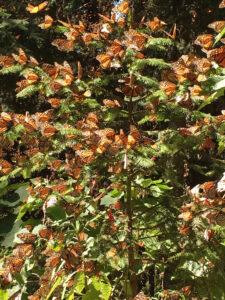
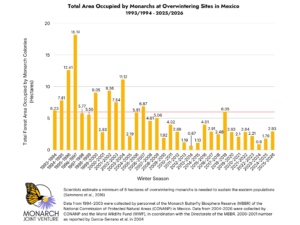
This month Mexico’s National Commission of Protected Natural Areas (CONANP) and the World Wildlife Fund published their population census of overwintering monarch butterflies (Danaus plexippus) and found a 64% increase over last year, an important indication of growth in monarch numbers for the eastern United States. This census is conducted annually in the high-elevation oyamel fir forests of Central Mexico, where nearly all monarch butterflies in Eastern North America spend the winter. Rather than counting individual butterflies, the census measures the area of the forest where the butterflies roost. Last year, monarchs occupied about 1.74 hectares (4.4 acres). This year 2.93 hectares (7.24 acres) were occupied – the largest population observed in the last decade.
Why it matters
Each Spring, monarchs leave their overwintering grounds to head North into the southeastern United States, where they lay their eggs on milkweed plants. This generation takes up the next leg of the journey, producing offspring in midwestern states. By Fall, the migration continues with a fourth generation making their way back to Mexico. The total number of monarch butterflies that make it back by Winter is dependent on how well prior generations fared based on weather conditions, host plant availability and overall environmental quality. While the overwintering population fluctuates from year to year, this year’s large winter population in Mexico is a sign that monarchs are off to a good start for this year’s migration cycle.
What you can do to help
Monarchs the have been in steep decline for more than 25 years largely due to habitat loss and pesticide use. One of the best ways to help monarchs is to plant native milkweed and other wildflowers to serve as a food source for caterpillars and adults alike. Reducing or eliminating pesticide use is another best practice for supporting monarchs and other pollinators. You can also participate in the Certified Wildlife Habitat program to meet the needs of wildlife wherever you live, work, learn, play or worship.